
Klaus Weber · DTM-Korrespondent
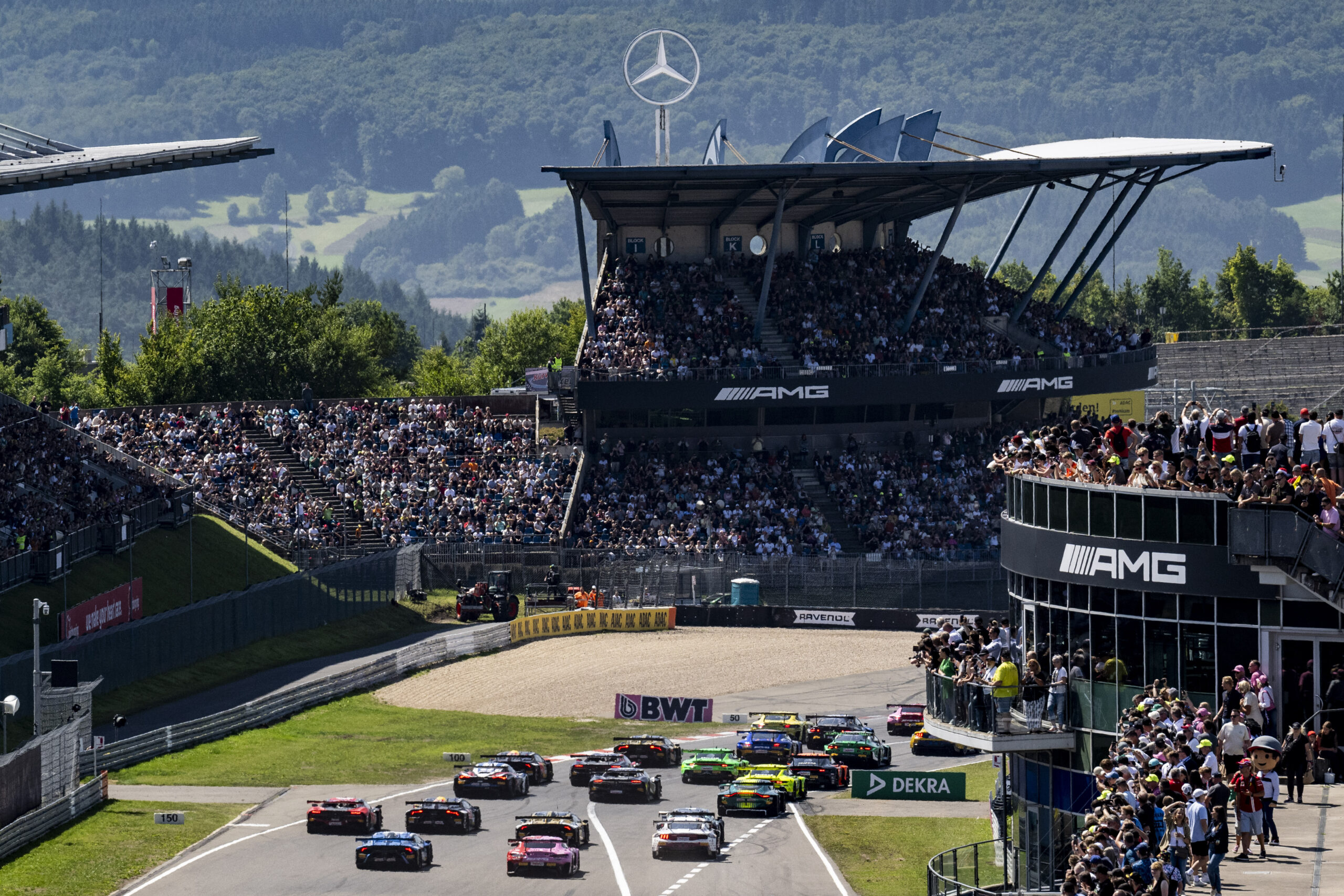
In the opening free practice session for the DTM round at Nürburgring, 21 cars are bunched within less than one and a half seconds, a figure that underscores the impact of the current Balance of Performance adjustments.
Matteo Cairoli set the fastest lap of the first practice session for Emil Frey Racing with a time of 1:26.144, claiming the headline time ahead of Lucas Auer in the Mercedes-AMG for Team Landgraf, who trailed by 0.053 seconds. More striking than the top time itself is the compactness of the field: between Cairoli in first place and Christian Engelhart in last, there are just 1.394 seconds spread across 21 cars from twelve different teams.
Tight top five, clear pattern emerging
Behind Cairoli and Auer came Marco Mapelli (Abt Sportsline, 1:26.222), Marco Wittmann (1:26.261), and Kelvin van der Linde (1:26.289), both for Schubert Motorsport, rounding out the top five. The gap from first to fifth is just 0.145 seconds, a figure that in free practice with varying fuel loads and tire conditions says little about actual race trim pace, but clearly demonstrates how close the vehicle concepts are under the current Balance of Performance.
Notably, the top five feature four different teams, with Schubert Motorsport represented twice in positions four and five. This suggests the BoP adjustments implemented before the weekend are working as intended: no single team dominates the opening session, instead tenths are decided by fine margins in setup and tire selection.
Team-internal differences stand out
Looking at teammate comparisons reveals larger spreads than at the front overall. At Emil Frey Racing, Cairoli and Thierry Vermeulen are separated by 0.603 seconds, with Vermeulen unable to break into the top 15. At Mercedes-AMG Team Landgraf, Tom Kalender sits in 12th place, 0.393 seconds behind Auer. Such gaps within a team often point in early practice to different programs, such as running long runs in race trim rather than qualifying attempts on fresh rubber.
At Abt Sportsline and Schubert Motorsport, internal gaps are noticeably tighter: Mapelli and Luca Engstler sit 0.157 seconds apart, Wittmann and van der Linde separated by just 0.028 seconds. Both teams demonstrate consistent setup balance across both cars, suggesting the base setup for Nürburgring was already locked in before the session and primarily fine-tuned during practice.
Midfield and the gap to the tail
Even in the midfield, times are closely bunched: Arjun Maini (HRT Ford Performance, P7) through Bastian Buus (Land Motorsport, P17) span just 0.430 seconds, a range where eleven cars battle for hundredths. Notably, Comtoyou Racing shows a curious split: Nicki Thiim made it to 11th place (1:26.570), while teammate Nicolas Baert only reached 20th (1:27.312), a 0.742-second gap, the largest within any team on the entire grid.
Christian Engelhart in the TGI Team by GRT ended the timing sheet in isolation at 21st place with 1:27.538, 0.226 seconds behind the next-closest Nicolas Baert. For a car that on paper should be competitive in the general field, that's an outlier that needs explaining in the second session. Overall, though, practice one confirms one thing above all: with a field spread of under 1.4 seconds, qualifying at Nürburgring will be decided by tenths rather than half-second margins, and every team will need to determine whether their internal gap stems from driver differences, program choices, or actual handling deficits.