
Marco Rossi · F1 Correspondent
A cracked sump brought Andrea Kimi Antonelli to the brink of retirement in Mexico. It would not have cost him the title, but it would have cost him the podium, as Mercedes revealed only days later.
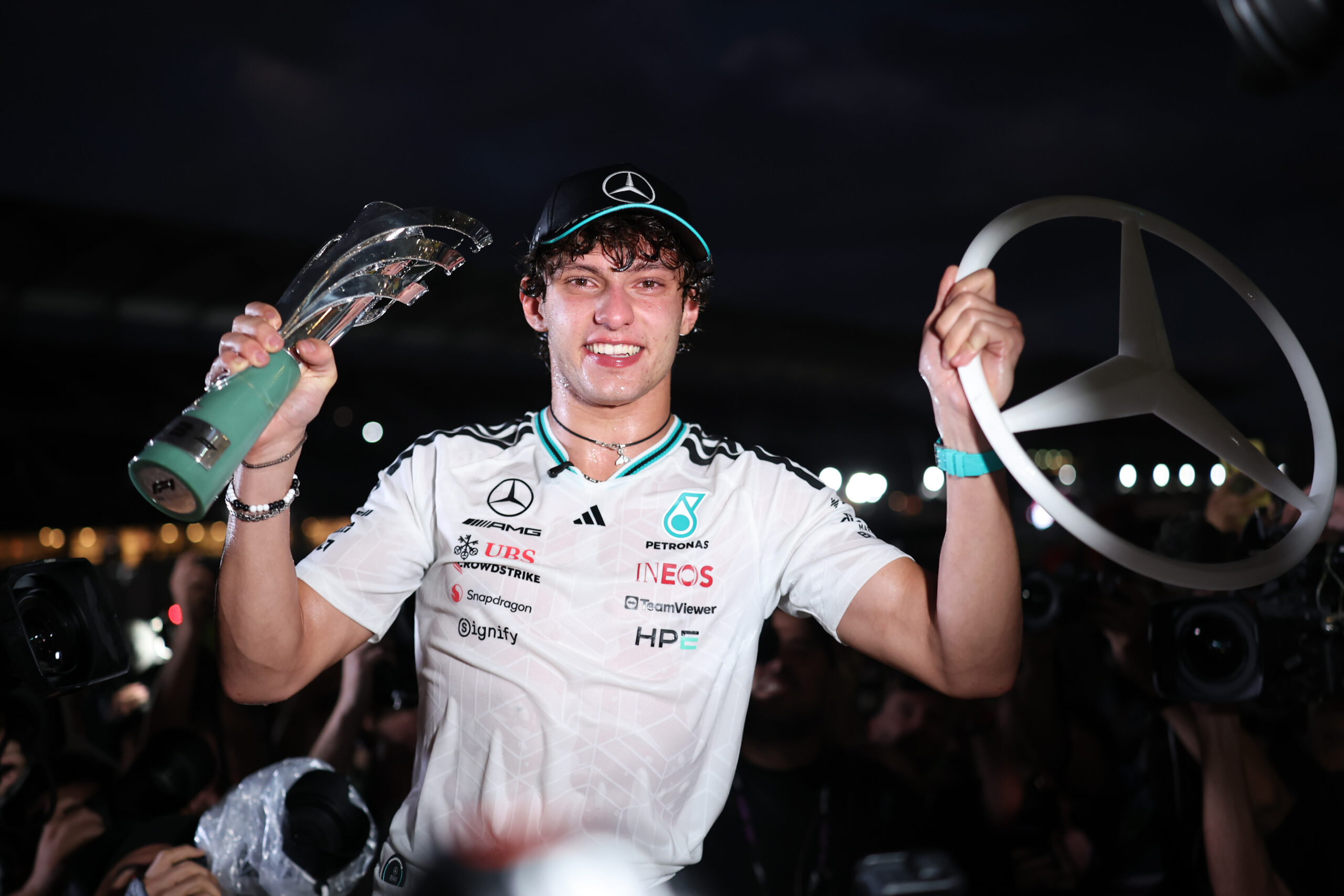
At 20 years and 68 days, Andrea Kimi Antonelli became the youngest world champion in Formula 1 history at the Mexico City Grand Prix, taking that record from Sebastian Vettel. The Mercedes driver sealed the title with third place behind Max Verstappen and Lewis Hamilton, a result that at first glance looked like a composed run to the flag. Just how close that run actually came to a retirement only emerged days after the race, when Mercedes deputy team principal Bradley Lord revealed details about the state of Antonelli's Mercedes W17 on the High Performance Racing podcast.
A cracked sump in the final laps
Around four laps from the end, Antonelli noticed that his power unit was losing performance and becoming increasingly hard to drive. What felt to the Italian like an uneasy feeling in the cockpit was, according to Lord, the result of a cracked sump that almost forced the W17 to retire in the closing laps. When the mechanics removed the car's floor after the finish, it was completely covered in oil, according to Mercedes' deputy team principal.
According to Lord, the engine held on to the finish and Antonelli came home third. Even a retirement would not have changed the outcome of the title fight, because neither Lewis Hamilton nor George Russell won the race. It would, however, have cost him the podium alongside Verstappen and Hamilton. That the title celebration on the podium was only minutes away from a technical failure became public only through Lord's account, not during the race itself.
From Mexico City to Fazenda Dois Lagos
While the analysis of his car was still underway, the newly crowned world champion had already travelled on to Brazil, where one name has meant more to him since childhood than any title of his own: Ayrton Senna. Together with his father Marco, Antonelli visited Fazenda Dois Lagos, the Senna family estate, spent time with Senna's relatives, among them Bruno Senna, and sat in the original 1986 Lotus 98T. On Instagram, Antonelli called it an unforgettable day, a choice of words that carries weight coming from a driver who is usually reserved about private moments.
A year earlier, Antonelli had already visited Senna's grave at Morumbi Cemetery ahead of the São Paulo Grand Prix. The bond between the two is more than a marketing story: since his Formula 1 debut, Antonelli has raced with number 12, the same number Senna carried at Lotus and in his first world title season with McLaren in 1988. That a 20-year-old world champion, in the very week after his greatest sporting success, chose to make a detour to his idol's family estate says a great deal about how deeply Senna shaped his idea of what it means to be a racing driver.
A helmet as tribute, a number as a statement
For the following race weekend in São Paulo, Antonelli announced a special helmet in his idol's design, a tribute that also marks 35 years since Senna's legendary home win in 1991. Senna finished that race with his gearbox stuck in sixth gear, a feat that is still told in Brazil as one of the great stories of the sport. That Antonelli chose this very moment for his tribute suggests a feel for history that goes beyond pure symbolism.
Even more remarkable is another decision: although as reigning world champion he would be entitled to number 1 from the 2027 season, Antonelli announced that he will keep racing with the 12. A gesture suggesting that for him the connection to Senna does not end with his first title but is only just gaining significance. For Mercedes, this season brings a double gain: the youngest world champion in history in its own ranks, and a driver who is clearly approaching his new role at the front of the field with great seriousness. How he fills this dual role as defending champion and Senna's heir next season promises to be one of the most intriguing questions of the coming year.